Car and roadside glossary
The words you hear when a battery dies, a tire goes flat or you’re locked out, explained plainly.
- Open 24/7
- Price before dispatch
- No membership
- English y Español
- 12-volt auxiliary battery
The small low-voltage battery in a hybrid or electric car that powers the computers, locks and lights. If it dies, a hybrid or EV may not unlock with the remote, power up or shift out of Park, even with a full main battery. In many models it sits in the trunk or under a seat, with jump points under the hood. Check the owner's manual before using a hybrid or EV to jump another car, since some makers warn against it.
- AGM battery (absorbent glass mat)
A sealed lead-acid battery that holds its acid in fiberglass mats instead of loose liquid. Many newer cars with start-stop or heavy electrical loads come with AGM from the factory, and they need AGM again at replacement time. Putting a standard battery in its place can lead to early failure and warning lights on the dash. AGM handles vibration well and resists spilling, which is why some cars mount it in the trunk or under a seat.
- Air wedge
A flat inflatable bag slipped into the door gap and pumped up to open a small space without prying metal. Lockout technicians pair the air wedge with a long-reach rod that presses the unlock button or pulls the inside handle. The soft bladder spreads the pressure, so with care it doesn't scratch paint, bend the door or tear the weatherstrip. Coat hangers and screwdrivers do exactly the damage this tool is made to avoid.
- Alternator
The belt-driven generator that recharges the battery and powers the electrical system while the engine runs. When it fails, the car runs on battery alone until the battery is drained, often with a battery light, dimming headlights or flickering gauges first. A healthy charging system usually shows about 13.5 to 14.7 volts at the battery with the engine running. A jump will restart a car with a dead alternator, but it will die again, and the alternator itself is a repair-shop job.
- Battery bank (semi truck)
The set of several 12-volt batteries, wired together, that starts a semi truck's diesel engine. Many semi trucks carry three or four batteries wired in parallel, so one bad battery can drag the whole bank down. Running a fridge, lights and devices in the sleeper overnight with the engine off is a common way to wake up to no crank. A big diesel needs far more current than a car can share, so a car-to-truck jump rarely works.
- Battery registration (BMS reset)
Telling the car's battery management system, with a scan tool, that a new battery has been installed. Many BMW, Audi and Volkswagen models, plus a lot of newer Fords and other cars with start-stop, adjust their charging as the battery ages. Skip the reset and the system may keep treating the new battery like the worn-out one, which can shorten its life and leave start-stop switched off. Give us the year, make and model when you call so the technician knows what the swap involves.
- Battery warning light
A battery-shaped dash light that means the charging system isn't keeping up, not always that the battery is bad. Once it comes on while you're driving, the car may be living on whatever charge is left. Shut off the A/C, radio, seat heaters and phone chargers, and make for a parking lot or a safe exit instead of pushing on to your destination. If the engine dies on the way, get as far off the road as you can while the car is still rolling.
- BCI group size
A standard code, such as 24F, 35, 48 or 65, that sets a battery's outside dimensions and where its terminals sit. The group size has to match for the battery to fit the tray, clamp down firmly and reach the cables without stretching them. A letter after the number, like the F in 24F or an R, usually means the terminals are reversed from the plain version. Some labels also show a European code, such as H6 for group 48.
- Bead (tire bead)
The stiff, wire-reinforced inner edge of a tire that seals airtight against the rim. Corrosion on an aluminum wheel or a hard curb strike can break that seal and cause a slow leak with no nail in sight. A tire driven flat or very low can slip off the rim entirely, and it has to be reseated with the right equipment. Never try to seat a bead with fire or spray tricks, because the tire can burst.
- Blowout
A sudden, rapid loss of air, often with a loud bang, that makes the car pull hard to one side. Hold the wheel firmly, ease off the gas and let the car slow on its own; slamming the brakes is what usually causes a loss of control. Once you're at a safe speed, signal, steer gently off the road and turn on your hazard lights. Underinflated tires run hot and summer pavement makes it worse, so pressure checks matter most in Texas heat.
- Booster cables (jumper cables)
A pair of heavy insulated wires with clamps that connect a good battery to a dead one. The usual order is red to the dead battery's positive post, red to the good positive, black to the good negative, then black to bare metal on the dead car away from the battery; take them off in reverse. A lower gauge number means thicker wire that carries current better, and longer cables help when the cars can't park nose to nose. Keep the clamps from touching each other while any end is connected.
- CCA (cold cranking amps)
The number of amps a 12-volt battery can deliver for 30 seconds at 0°F while holding at least 7.2 volts. CCA tells you whether a battery has the muscle to turn over a cold engine, so a replacement should match or beat the number your car calls for. Cranking amps (CA) are measured at 32°F and always read higher, so compare CCA to CCA. North Texas winters are mild most years, but a hard freeze quickly exposes a battery that was already weak.
- Core charge
A refundable deposit added when you buy a battery and returned when the old one is turned in for recycling. The deposit exists because lead-acid batteries are meant to be recycled and don't belong in household trash. If you buy a battery on your own, keep the old one and the receipt together until you return it. When we install a battery at your car, ask the technician what happens to the old one so you aren't left holding it.
- Crank, no start
The engine turns over at normal speed but never fires and keeps running. A strong, steady cranking sound means the battery is doing its job, so a jump usually won't change anything. The cause is more often fuel, spark, a sensor or the anti-theft system not recognizing the key. Slow, labored cranking that sounds like a struggle is a different story, and that one often is the battery.
- Donut spare (compact spare)
A small, narrow temporary spare meant only to get you to a tire repair. Read the label on the spare for its limits; many are rated for 50 mph and a short distance only. A donut usually takes much higher pressure than a regular tire, often 60 psi, and after years in the trunk it's commonly low, so check it before you need it. Braking and cornering feel different on one, so leave extra room.
- EFB battery (enhanced flooded battery)
A heavier-duty version of the standard liquid-acid battery, built for basic start-stop systems. EFB stands up to the constant restarts of start-stop far better than a regular flooded battery. If your car came with EFB, replace it with EFB or step up to AGM, but never step down to a standard battery. Going from AGM to EFB is also a step down, so read the label on the old battery before buying.
- Frontage road (service road)
The local road running alongside a Texas highway, usually one-way in the same direction as the lanes beside it. In Dallas–Fort Worth, many major highways have frontage roads lined with gas stations, stores and parking lots. If your car is failing but still moving, taking the next exit to the frontage road puts you somewhere far safer to wait than the shoulder of the main lanes. Say which side of the highway you're on, because the two frontage roads run in opposite directions.
- Full-size spare
A spare the same size as the tires on the car, sometimes mounted on a matching wheel. A matching full-size spare can usually be driven like any other tire, while a non-matching one, often on a plain steel wheel, may carry its own limits. On all-wheel-drive vehicles, a spare that's a different size or far less worn than the other three can strain the drivetrain, so check the manual. It loses air just sitting there, so give it a pressure check every few months.
- Hazard lights (flashers)
All four turn signals flashing at once, switched on with the red triangle button on the dash. Turn them on as soon as you know you're stopping, and leave them on the whole time you wait so other drivers and your technician can pick you out. They work even with the key out, but they fade on a dying battery, so if the battery is the problem, keep a flashlight handy.
- Hot car (child or pet locked inside)
A closed car in the sun heats up far past the outside temperature, and a child or pet inside can be in danger quickly. If a child or pet is locked inside a hot car, call 911 first, every time, before you call anyone to open the car. 911 can send help that is able to break a window if needed, and that comes before any other call, including ours. Leaving the windows cracked does little to keep a parked car cool.
- Immobilizer (anti-theft system)
A system that lets the engine run only when it recognizes the electronic chip in your key or fob. When it doesn't recognize the key, the car may crank but not start, or start and die after a second or two, often with a flashing key or security light. A jump won't help, and neither will a copied key that was cut but never programmed. Programming keys is work for a dealer or a locksmith who does it; opening a locked car is a separate job.
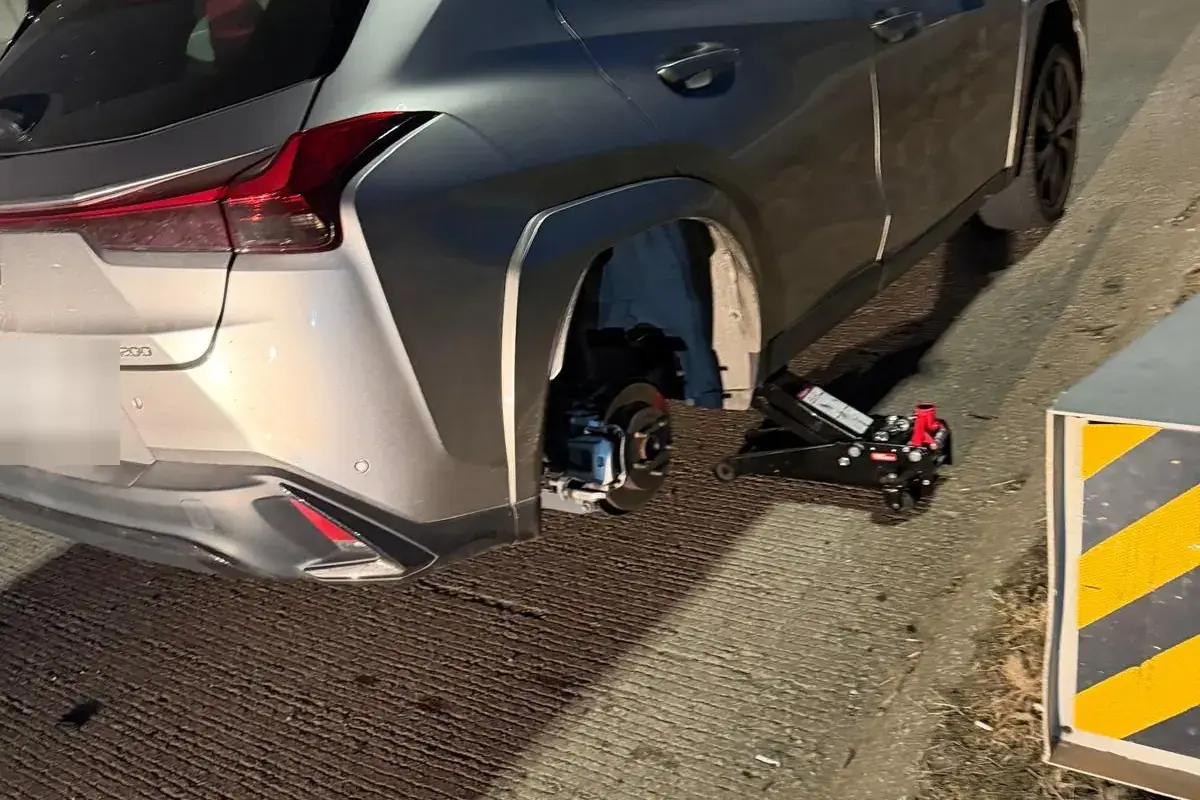
- Jack points (jacking points)
The reinforced spots under a car's body, shown in the owner's manual, where a jack can lift it safely. On many cars they are notches or arrows on the metal seam just behind the front wheels and just ahead of the rear ones. Lifting anywhere else can dent the floor or let the car slip off the jack. Use a jack only on firm, level ground away from traffic, and never put any part of your body under a car held up by a jack alone.
- Jump start
Borrowing power from another battery or a portable pack to crank an engine whose own battery is too low. After a jump, keep the engine running and drive for a good while so the alternator can put charge back in. Never jump a battery that is cracked, leaking, swollen or frozen, because it can burst. If the car needs another jump within days, the battery or the charging system needs a closer look.
Jump start, Mobile battery replacement, Semi truck jump start
- Jump starter pack
A portable battery, usually lithium, with built-in clamps that can start a car without a second vehicle. A pack only helps if it's charged, so top it up every few months and after each use. Summer heat inside a parked car in Texas can go past what many lithium packs are rated to be stored at, so one that rides in the trunk all year may fade or swell. If the pack shuts itself off or the engine barely turns, the battery may be too far gone for a small unit.
- Key fob
The remote on your key ring that locks, unlocks and sometimes starts the car. Most run on a coin-cell battery, often a CR2032, and the first sign it's dying is having to get closer or press the button more than once. On most cars, swapping that cell is simple and doesn't call for reprogramming. If the remote stops working entirely, the metal key hidden inside the fob can still open the driver's door.
- Lug nut
One of the threaded nuts that hold a wheel tight against the car's hub. Most cars use four to six per wheel, and some European models use lug bolts that thread straight into the hub instead. They loosen counterclockwise, and steady pressure from a long bar or your body weight on the wrench works better than jerking on it. If one won't budge, spins without loosening or the socket slips, stop before you round it off.
Flat tire change, Stripped lug nut removal, Wheel lock removal
- Mile marker
A small numbered sign along a highway that shows the distance in miles from a fixed starting point. On Texas interstates, exit numbers follow the same mileage, so the last exit number you passed is nearly as good as a marker. When you call for help, give the highway, the direction you were heading and the nearest marker or exit, so dispatch can place you on the right side of the road. Where there are no markers, the last cross street or exit name works.
- Move It law (minor crash)
A Texas rule that, after a crash with no injuries on a metro-area highway, drivers move any vehicle that can still be driven out of the main lanes. Sitting in a travel lane waiting for police raises the risk of a second crash, so get to the shoulder, an exit or a nearby lot first, then trade information and make your calls. If anyone is hurt or a car can't be driven safely, leave it where it is, stay buckled in with hazards on and call 911.
- Move Over or Slow Down law
A Texas law that makes drivers leave the lane next to certain stopped vehicles with lights flashing, or slow down. It covers police, fire and ambulance crews, tow trucks, TxDOT and utility trucks, garbage and recycling trucks, toll road vehicles and, since September 2025, animal control and parking enforcement. If you can't safely change lanes, drop to 20 mph below the limit, or to 5 mph where the limit is 25 or less. Giving the same room to any car stopped on the shoulder is plain good sense.
- Parasitic drain
Power that keeps flowing out of the battery after the car is shut off and locked. A small draw for the clock, alarm and computer memory is normal, but a stuck trunk or glove-box light, a dash cam in parking mode or a module that never goes to sleep can flatten a battery overnight or over a few days. If the car starts fine after a jump but is dead again every morning, suspect drain before blaming the battery. Tracking down the exact circuit takes a meter and patience, usually at a repair shop.
- Patch repair (tire patch)
A rubber patch bonded to the inside of the tire over a puncture, after the tire comes off the wheel. Taking the tire off lets the inside be checked for damage from driving on it low, which a plug can't reveal. A patch alone seals the liner but leaves the hole through the tread open to water and dirt, which can reach the steel belts. That's why industry guidelines pair the patch with a filler in the hole.
- Plug repair (tire plug)
A sticky rubber strip pushed into a puncture from the outside of the tire to stop the leak. A plug goes in without taking the tire off the wheel, which makes it quick when the hole is small and in the tread. Tire industry guidelines don't count a plug alone as a complete repair, because the inner liner isn't sealed or inspected. Ask which kind of repair your tire got, and keep in mind a plug never belongs in the shoulder or sidewall.
- Plug-patch (combination repair)
A one-piece repair with a rubber stem that fills the puncture and a patch that seals the inside of the tire. This is the repair tire industry guidelines call for, since it fills the hole and seals the liner in one step. It applies only to punctures in the tread area up to about a quarter inch across. Damage in the shoulder or sidewall, or a bigger hole, means the tire should be replaced.
Tire repair, plug and patch, Screw or nail in tire, Tire replacement
- Remote jump terminals
A positive post and a ground point under the hood for cars whose battery sits in the trunk or under a seat. The positive post usually hides under a red plastic cap near the fuse box, and the owner's manual shows where the negative clamp goes. Using these points saves you from tearing apart a trunk floor or a seat in the dark. If there's no battery under the hood, look for that red cap before you start pulling panels.
- Reserve capacity (RC)
How many minutes a fully charged battery can supply 25 amps at 80°F before it falls to 10.5 volts. Reserve capacity is your cushion if the alternator quits: roughly how long the car can keep its lights, fuel pump and ignition going on battery power alone. A higher RC also helps cars that sit for days with lots of electronics drawing current. Look for it on the label next to the CCA, listed in minutes.
- Resting voltage
A battery's voltage after the car has sat off for a few hours, the simplest check of how much charge is left. About 12.6 volts or a little higher means fully charged, around 12.2 is roughly half, and below 12.0 the battery is close to flat. A reading taken right after driving looks better than the truth, so wait, or switch the headlights on for a minute first to burn off the surface charge. Voltage alone can't reveal a battery that has lost its strength; that takes a load test.
- Run-flat tire
A tire with stiff, reinforced sidewalls that can carry the car a limited distance after losing air. The usual limit is about 50 miles at no more than 50 mph, but your owner's manual has the numbers for your car. Because the sidewalls don't sag, a run-flat can be nearly empty without looking low, so the TPMS warning is your main clue. Cars sold with run-flats often have no spare, and many makers say a run-flat driven without air should be replaced, not repaired.
- Shoulder (road shoulder)
The paved strip outside the travel lanes, meant for emergency stops. If you must stop, use the right shoulder and get as far from the lane as you can; the left shoulder beside a median wall leaves no way out. A shoulder next to moving traffic is no place to change a tire, so if the car still rolls slowly, get to an exit, a frontage road or a parking lot first. While you wait, stay buckled in with hazards on, or if there's a guardrail and a safe path to it, wait behind it away from the car.
- Sidewall
The smooth side of the tire between the tread and the wheel, where the size and date are printed. The sidewall flexes constantly, so a cut, puncture or gouge there can't be safely repaired. A bulge or bubble means cords inside have broken and the tire could fail without warning, even while it holds air. Driving any distance on a flat can crush the sidewall from the inside, which is why a tire that ran flat often can't be saved.
- Slim jim
A thin metal strip slid down inside a door to hook the lock linkage, a method from older cars. Modern doors hide side-airbag sensors, wiring and shielded lock rods, so fishing around inside with a strip of metal can damage parts that are hard to fix. Professionals open today's cars with an air wedge and a long-reach tool instead. If someone shows up planning to slide a strip down your window, it's fair to ask how else they can open it.
- Smart key (proximity key)
A key fob the car senses nearby, so the doors unlock and the engine starts without the key leaving your pocket. When the fob's battery weakens, the car may show 'key not detected,' but most models have a backup, often holding the fob right against the start button. Look up the method for your car in the manual now, not at night in a parking lot. Many cars try to keep you from locking a smart key inside, but it isn't foolproof, especially with a weak fob battery.
- Star pattern (crisscross tightening)
Tightening lug nuts in a crisscross order instead of working around the circle. Crisscrossing pulls the wheel flat against the hub so it seats evenly instead of cocking to one side. Snug every nut by hand first, lower the car until the tire carries weight, then tighten in the pattern to the torque spec. A wheel tightened around the circle can wobble or vibrate even when every nut feels tight.
- Start-stop system
A feature that shuts the engine off at stops and restarts it when you lift your foot off the brake. All those restarts are why these cars need an AGM or EFB battery rather than a standard one. As the battery weakens, the system often stops shutting the engine off before anything else goes wrong, so a start-stop that has quietly quit working is a good hint to have the battery tested.
- Starter (starter motor)
The small, powerful electric motor that spins the engine when you turn the key or press the start button. Rapid clicking with dim dash lights usually points to a weak battery, while one loud click with bright lights points more toward the starter or its wiring. A jump fixes the first case but not the second. Replacing a starter is repair-shop work, so it helps to know which sound you heard before you call.
- Stripped lug nut
A lug nut whose threads are damaged or whose corners are rounded so a socket can't grip it. It usually comes from cross-threading, the wrong socket size or an impact gun set too high. Forcing it can snap the stud or damage the wheel, and a nut that spins but never loosens may have a stripped stud behind it. Stop and call for removal instead of reaching for a hammer.
- Swollen lug nut (capped lug nut)
A two-piece lug nut whose thin decorative cap has bulged from corrosion, so the factory-size socket no longer fits. Many pickups and SUVs use these chrome- or steel-capped nuts, and moisture trapped under the cap slowly pushes it out of shape. Most people find out at the worst moment, when the lug wrench from the spare kit won't slide on. Swapping them for solid one-piece nuts ends the problem for good.
- Terminal corrosion
White, green or bluish crust that builds up on battery posts and cable clamps. That crust blocks current, so a car can click or crank weakly even when the battery still holds a charge. With the engine off, it can be scrubbed away with baking soda, water and a wire brush, wearing gloves and eye protection, taking the negative cable off first and putting it back last. Heavy buildup that keeps coming back can point to a leaking battery or a charging problem.
- Texas U-turn (turnaround)
A dedicated lane at a highway interchange that swings you from one frontage road to the other without stopping at the lights. Turnarounds are an easy way back if you exited on the wrong side or rolled past a safe place to stop. Not every interchange has one, and they're marked with a U-turn arrow on the frontage road. Drivers often come through them quickly, so wait in a lot rather than at the mouth of the turnaround.
- TEXpress lanes (managed lanes)
Tolled lanes built into several DFW highways and kept apart from the main lanes by barriers or posts. You can get on and off only at marked entry and exit points, so a car that quits inside has nowhere to go. If yours is still rolling, keep going to the next exit; if it stops against the barrier, stay inside with your belt on and hazards flashing, and call 911 first. The lanes are set up for drivers with a toll tag; without one, the toll is billed by mail.
- Tire sealant kit (tire mobility kit)
A small compressor and a bottle of sealant that many newer cars carry instead of a spare tire. The sealant can close a small puncture in the tread, but it won't fix a cut, a sidewall injury or a tire that came off the rim. Tell whoever repairs the tire that sealant was used, because it coats the inside and can foul the pressure sensor. The bottles carry an expiration date, so check yours.
Tire repair, plug and patch, Screw or nail in tire, Flat tire change
- Toll tag
A sticker transponder on the windshield that pays tolls automatically as you pass under the readers. Tags from the major Texas toll agencies work on toll roads across the state, and DFW toll roads have done away with cash booths, so without a tag the bill goes by mail to the plate's owner. The sticker is made to break if peeled off, so a new windshield usually means a new tag. In a rental or borrowed car, find out whose account the tag is on before you take a toll road.
- Torque spec
The exact tightness, in foot-pounds, that the carmaker sets for the lug nuts. Too loose and a wheel can work itself off; too tight, often from an impact gun, and studs stretch or nuts seize until the next flat. The number is in the owner's manual and varies between cars and trucks. Whenever a wheel goes back on, have the nuts re-checked with a torque wrench after a short drive.
Flat tire change, Stripped lug nut removal, Tire replacement
- TPMS (tire pressure monitoring system)
The system that turns on a dash warning when one or more tires drop well below the recommended pressure. In US cars the light must come on by the time a tire is about 25 percent low, so treat it as a real problem, not a reminder. A light that flashes for a minute or so and then stays solid usually means a sensor or system fault rather than low air. The right pressure is on the sticker in the driver's door jamb, not the maximum molded into the tire.
Tire repair, plug and patch, Screw or nail in tire, Valve stem replacement
- Tread depth
How deep the grooves in a tire's tread are, measured in 32nds of an inch. The wear bars molded across the grooves sit at 2/32 inch, the point where a tire counts as worn out; if a penny placed head-down shows all of Lincoln's head, you're there. Grip on wet pavement drops well before that, which matters when a sudden North Texas storm puts water on the road. Wear on just one edge points to alignment or pressure problems worth checking.
- Underbody spare (under-truck spare)
A spare tire that hangs under the rear of a pickup, minivan or SUV on a cable lowered with a crank. The crank rod usually feeds through a small access hole near the rear bumper or tailgate, and some trucks lock that hole with the vehicle key. Years of road grime and rain can rust the cable or winch until it refuses to let go. Lower it once in your driveway so you know it works before you need it on the road.
- Valve stem
The small tube on the wheel where air goes in, with a spring valve inside and a cap on top. Rubber snap-in stems crack with age and Texas heat, and a cracked one can leak slowly or all at once. Metal stems are often part of the tire pressure sensor. A dab of soapy water that bubbles at the stem confirms the leak, and keeping the cap on keeps dirt out of the valve.
- Wheel lock (locking lug nut)
A special lug nut with a unique pattern, usually one per wheel, that only its matching key can turn. Wheel locks are there to stop wheel theft, but they also stop you, or anyone helping you, from changing a flat when the key is missing. They're easy to spot because they look different from the other lug nuts. If you buy a used car, confirm the key came with it long before you need it.
- Wheel-lock key (lug nut key)
The patterned socket adapter that fits a car's wheel locks so a regular lug wrench can turn them. Check the glove box, center console, trunk side pockets, spare-tire well and tool kit before you decide it's lost. Many come with a code card for ordering an exact replacement, so keep that card at home, not in the car. If the key is gone and you have a flat, wheel-lock removal is the service to ask for.