Updated · Tires
Don't pull it out
The nail or screw is often what's keeping the air in. Pull it, and a slow leak can become a flat on the spot. Leave it until the tire is being repaired.
If you hear a ticking that speeds up as the car speeds up, it may be a nail head tapping the pavement each time the tire turns.
Find where it is
Look at the tread. Where the nail sits decides whether the tire can be saved:
- Main tread, away from the edges: usually repairable
- Shoulder, where the tread curves into the sidewall: usually not repairable
- Sidewall: not repairable
- A hole larger than 1/4 inch, or a cut instead of a puncture: not repairable
Check how fast it's leaking
Use a gauge and compare the reading with the door-jamb number. If the tire is close to normal and stays there over a few hours, the leak is slow. Spray soapy water around the nail; steady bubbles show air escaping.
A slow leak buys you a little time, not weeks. Nails can work loose, and a tire that runs low on hot Texas pavement heats up and can be damaged inside.
Can I drive on it?
If the tire is holding air and the nail is in the tread, a short, careful drive to get it fixed is usually fine. Stick to surface streets, skip the freeway, and check the pressure again before you go.
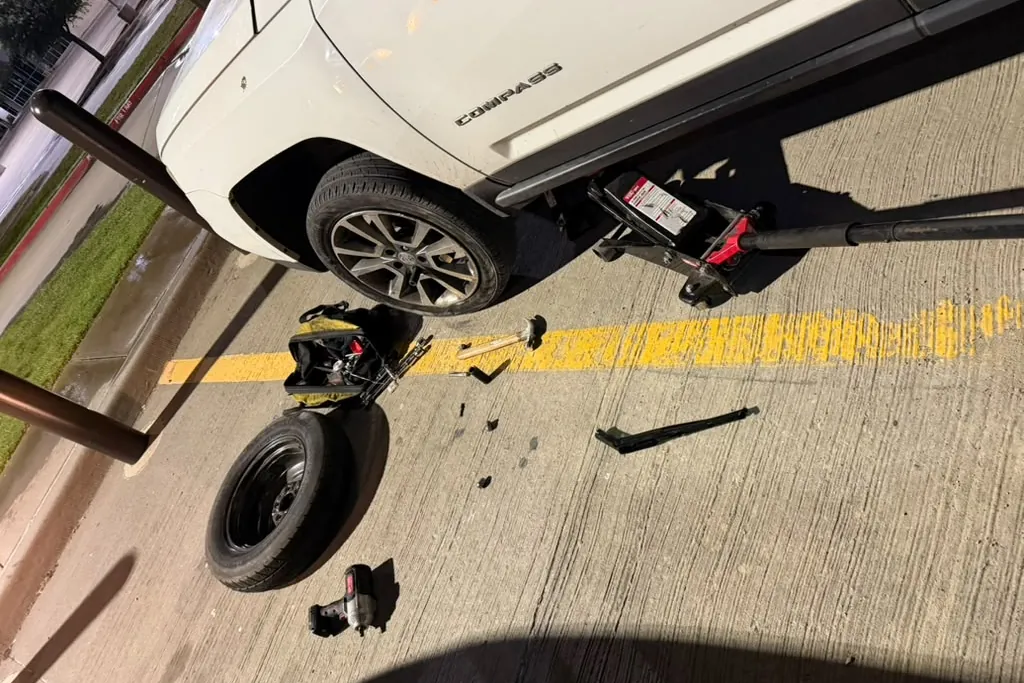
If the tire is low or flat, don't drive on it. A tire driven flat can't be repaired, and the wheel can be damaged too. Put on the spare in a safe spot away from traffic, or call for help.
Why it keeps happening around DFW
With so much road work and new building across the Metroplex, nails and screws end up on streets and in parking lots near job sites.
A technician can repair a nail or screw puncture in the tread right where you're parked. If it's in the sidewall or shoulder, we can put on your spare or bring a replacement tire instead.